Chen Taijiquan Starter Course
The Original Method of Tai Chi Taught Through a Clear, Structured Path
Discover the foundational practices of Chen Taijiquan through lineage-based instruction, including the 13 Postures, Silk Reeling, Standing Practice, Fajin training, martial applications, and the principles that connect them.
Instead of piecing together random exercises and disconnected techniques, you'll learn the method in a logical progression that helps you build understanding, skill, and confidence from the very beginning.
Rooted in the Chen family lineage of Grandmaster Chen Quanzhong, with training context to help you connect the movements, principles, and applications.
Start with the method, not guesswork
Inside the Tai Chi Starter Course, you'll learn foundational Chen Taijiquan practices, principles, applications, and training methods through a structured progression designed to help you train with clarity, confidence, and purpose.
Guided orientation
See how the course fits together and where to begin.
Core teaching principles
Study the method behind the movements, not just the outer shape.
Focused review videos
Return to key details without rewatching full lessons.
Applications starter guide
Discover the martial purpose, timing, and intent behind key movements.
Deeper principles
Explore the connections between posture, movement quality, internal development, and martial function.
Course completion reward
Eligible graduates may receive a tuition reward credit toward continued lineage training.
Chen Taijiquan is built on more than choreography. Throughout the course, you'll be introduced to foundational concepts such as the 13 Postures, Silk Reeling, and Fajin, while learning how these principles connect to structure, movement, martial application, and the Chen family teaching tradition.
You'll receive guided instruction, review resources, lineage context, application training, and downloadable study materials designed to help you move beyond simply copying movements and begin understanding the method itself.
Whether you are taking your first steps in Tai Chi or deepening an existing practice, the course provides a structured path into the principles, training methods, and traditions that have shaped generations of Chen practitioners.
Enroll in the Tai Chi Starter Course for a single tuition payment of $100, with a special tuition credit available toward eligible Taijiquan Lineage Training Programs.
What's Included in the Tai Chi Starter Course
Tai Chi 13 Postures Form
- Unlock the 13 Postures (Shi San Shi), the foundational energies and principles that form the backbone of traditional Taijiquan and give life to every Tai Chi form.
- Most students focus on collecting movements. The 13 Postures teach you to recognize the principles behind them, helping you move beyond memorization and begin training like a Tai Chi practitioner.
Post Standing Neigong
- Develop balance, stability, and whole-body connection through Zhan Zhuang (Standing Practice), a foundational training method that contributes to the legendary rooting and structural strength of Taijiquan.
- Learn the traditional Qi Sinking exercise used by generations of Chen family masters to cultivate rooting, deepen internal connection and amplify energy, force, and striking power.
5 Key Stepping Patterns Set
- Master the 5 Stepping Patterns of Taijiquan, the foundation of agile, balanced movement in every direction while maintaining your center, structure, and stability.
- More than footwork, these stepping methods teach you how to remain centered while life moves around you, helping you develop the balance, confidence, and adaptability that define skilled Tai Chi practitioners.
4 Directions "Jin" Set
- Develop the 4 Directions Jin, a foundational training set that teaches you how to express Tai Chi power and intent through every movement.
- Discover how to transition seamlessly between complementary energies, learning to change from Yin to Yang, Yang to Yin with the fluidity and adaptability that define skilled Tai Chi practice.
Tai Chi Body Opening Warm Up Set
- Practice the traditional Tai Chi Body Opening Warm Up Set, a Nei Gong method designed to relax and open the body while improving mobility, coordination, and overall movement quality.
- Through targeted exercises for the neck, shoulders, elbows, wrists, spine, waist, knees, ankles, and feet, you'll begin releasing accumulated tension and rediscover the freedom of movement that makes Tai Chi feel alive.
Fajin Power 4 Corners Set
- Train the Fajin Power 4 Corners Set, a traditional method used by generations of Chen masters to develop the explosive issuing power that distinguishes Chen Taijiquan from many other Tai Chi systems.
- As you practice these four rarely taught Fajin energies, you'll begin understanding how relaxed movement, structure, and intent combine to produce the sudden power often described as "Cracking Like Thunder."
Silk Reeling Energy Refining Secrets
- Practice Silk Reeling (Chan Si Jin), the signature body method of Chen Taijiquan used to refine internal connection, develop whole-body coordination, and cultivate Taiji Jin (Refined Power).
- Often described as meditation in motion, these traditional Nei Gong exercises help you move beyond mechanical technique and begin experiencing the continuous, spiraling power that makes Chen Taijiquan unique.
Essential Tai Chi Self-Defense Combat Applications
- Explore the martial applications behind Tai Chi's most important movements and begin understanding the principles that turn form practice into practical skill.
- Watch detailed demonstrations from multiple angles as I teach my son how the core energies of Taijiquan function in application, revealing the purpose, intent, and hidden meaning behind the movements.
- As your understanding grows, you'll begin seeing beyond the outer choreography and recognizing the martial logic that has been preserved within the art for generations.
Tai Chi First Form Practice Video
Follow along with the 36 Movement Chen Taijiquan First Form and begin developing the smooth, connected movement often described as the ability to "Flow Like Water."
The 36 movements follow the same sequence and principles as the longer 72 Movement Form, making it easier to learn while preserving the Silk Reeling energy, body method, and power development of the traditional Chen Taijiquan system.
More than just a practice video, this form offers a glimpse into the depth and sophistication of the complete Chen Taijiquan lineage system. As the movements begin to connect, you'll start experiencing how posture, structure, Silk Reeling, and intent come together to create the feeling that has drawn generations of practitioners to the art.
Beautifully filmed and accompanied by the sublime Gu Zheng music of The Rising Moon by Ms. Bing Xia, these practice sessions create an immersive training experience you'll want to return to again and again.
Included Bonuses...
✔ BONUS: Teaching Commentary
These detailed teaching commentaries were originally recorded for indoor students and contain many of the subtle explanations, training cues, and principles that are often overlooked during practice.
They help beginners progress more quickly while giving experienced practitioners a deeper understanding of the body mechanics, energy development, and martial function behind the movements.
✔ BONUS: Health Benefits of Tai Chi PDF Download
Johns Hopkins-trained health science researcher Dr. Ted Nawalinski has reviewed and summarized scientific research on the health benefits of Tai Chi in a convenient PDF guide.
In plain English, you'll discover why Tai Chi has been studied by leading research institutions and incorporated into programs at respected organizations such as Harvard Medical School, Johns Hopkins, and the Mayo Clinic.
Best of all, Dr. Nawalinski includes the original journal citations so you can explore the research and verify the findings for yourself.
✔ BONUS: Principle of Tai Chi Masterclass
These five videos lessons were recorded from one of my exclusive private seminars and explore key concepts that help transform Tai Chi from something you imitate into something you understand. Rather than simply collecting more movements, you'll go deeper into the principles that give the art its power and meaning.
Explore Taijiquan style differences, posture requirements, Silk Reeling principles, Yin and Yang theory, the deeper meaning of Kung Fu, and the Four Direction Energies of Peng, Lu, Ji, and An.
These lessons help you practice with greater clarity, purpose, and confidence while developing a deeper appreciation for the profound principles that make Tai Chi a lifelong art.
✔ BONUS: Complete Tai Chi Set List PDF Download
Never lose your place during practice again. This convenient reference guide contains the complete sequence of every exercise taught in the course, making it easy to review, practice, and stay on track.
Whether you're training independently or reviewing a lesson, you'll always know what comes next so you can spend less time trying to remember movements and more time developing skill.
✔ SPECIAL BONUS: Interview with Grandmaster Chen
Interviews with Grandmaster Chen Quanzhong Gain access to three rare translated interviews featuring Grandmaster Chen Quanzhong, 19th Generation Chen Family Grandmaster and one of the world's most respected Taijiquan teachers.
Discover his personal story, his views on health and Taijiquan, the responsibility of preserving a lineage, and the principles that guided a lifetime of practice and teaching.
You'll also witness Grandmaster Chen's remarkable fluidity, structure, and power in demonstration, offering a living example of where sincere practice can lead over decades of dedicated study.
More than historical recordings, these interviews provide a direct connection to the lineage, helping you better understand the art, the tradition, and the people who devoted their lives to preserving it.
✔ BONUS: Course Completion Reward
The Tai Chi Starter Course contains enough material to keep many students productively training for years. There is no requirement to continue beyond it.
Yet a small number of students discover that the deeper they go into the principles, applications, and training methods of Chen Taijiquan, the more they want to explore the complete curriculum.
For those students, successful completion of the Starter Course may qualify you for a Tuition Reward Credit toward one of our annual Lineage Training Programs, including a $100 credit toward Taijiquan for Health or a $200 credit toward the Taijiquan Martial Program.
Think of it as a reward for commitment. Should you decide to continue your training, your Starter Course tuition can become part of your next stage of study instead of being left behind.
Backed by our full 30-day, no questions asked guarantee.
Ancient China: Late 1500s
General Chen Wangting, 9th generation Chen family in China, had served his country for many years and retired to his ancestral village, Chen Jiaogou.
As fate would have it, his peaceful retirement was interrupted by the threat of roving marauders.
Renegade soldiers turned bandits pillaged the land and threatened the Chen Family Village. The imperial government was no help as they had become entangled in ceaseless wars against the northern barbarians.
The only "troops" available to the General were the local villagers. The Chen family was known for practicing a powerful martial art called Pao Chui, or Cannon Fist, but they were farmers, not trained soldiers.
In contrast, many of the bandits were seasoned veterans who knew military combat methods and were hardened by constant fighting.
There was another problem... General Chen was old. How could he expect to keep up with the demands of fighting younger, stronger men?
Heeding the advice of the legendary strategist, Sun Zi, General Chen realized he must use Unorthodox methods to defend his village against the bandits.
The General combined the Chen Family's powerful art of Pao Chui with military weapons, methods and tactics. To overcome the advantages of his younger opponents, he incorporated ancient Daoist Neigong secrets to build Internal Power... not as a replacement for external strength, but as a "Force Multiplier."
The Chen Family used these innovative methods to not only defend their village from bandits, but also to improve and extend the quality of their life. It spawned a revolution in the martial arts of combining life nourishing skills with life protecting skills.
Over the centuries, many derivative styles emerged. Yang, Wu, Hao, Sun, Beijing Simplified, Cheng Man Ching, and numerous other branches trace their origins back to the original Chen family Taijiquan methods. While many later teachers only got part of General Chen's art, there is one line that inherited the complete system.
Considered a priceless family treasure, Chen Taijiquan was passed down in an unbroken lineage from General Chen Wangting to Grandmaster Chen Quanzhong, the 19th generation inheritor of Chen Taijiquan.
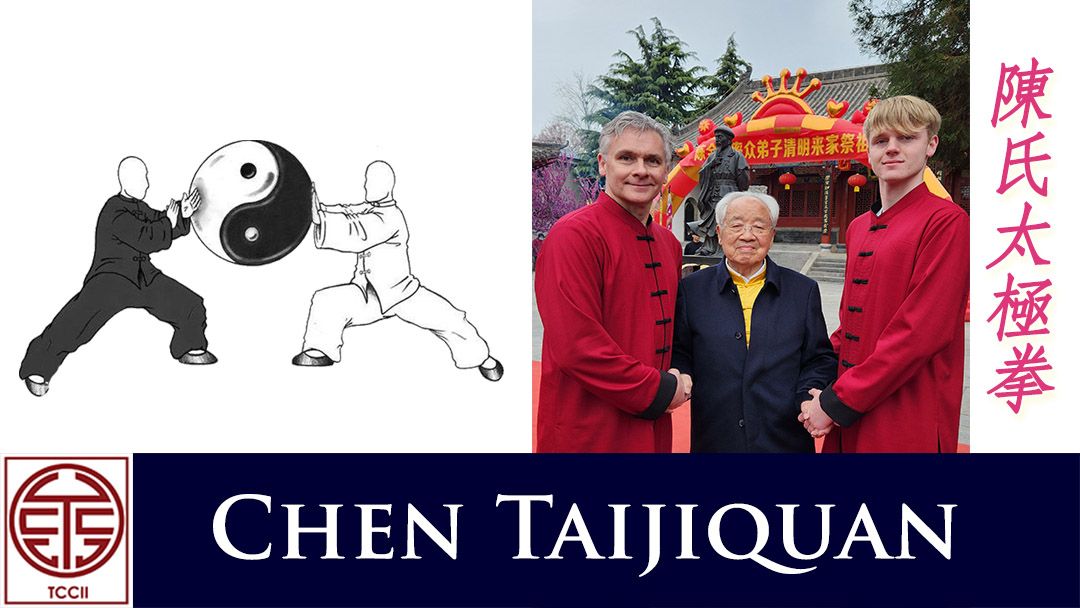
Shifu Shawn Cartwright, International Grandmaster Chen Quanzhong, Drake Cartwright
Grandmaster Chen Quanzhong was among the senior-most Chen Family Taijiquan Grandmasters in the world. His teaching preserved one of the oldest and rarest methods of Taijiquan in existence. He studied with several legendary Grandmasters whose lineages reached back to the 1800s and was entrusted with the Original Chen Taijiquan family legacy.
Grandmaster Chen Quanzhong's method preserves the oldest and most original of all the systems. These include the true Yin-Yang practice methods, Chan Si Jin (Silk Reeling) energy, Fajin power, weapons, and devastating martial applications.
I am forever grateful that Grandmaster Chen taught me the Chen Family Tai Chi Chuan system before he transitioned to the next world.
My students call me Shifu Shawn Cartwright. Shifu is a Chinese term that literally means "Father Teacher". I'm the 20th Generation Indoor Student of Grandmaster Chen.
Because Grandmaster Chen taught me like his own son (I'm his adopted Taiji son, which means I inherit his system... not his car)
I taught my son, Drake Cartwright, like... well... he's my own son (of course, he also gets the car).
Because the complete original Chen Taijiquan system is so rare and difficult to find, I decided to document the entire system for posterity as I was teaching Drake.
Recall that "Shifu" is a Chinese term that literally translates as "Father-Teacher." The deeper meaning is that a real Shifu will teach his students like they were his own son.
Which is why we decided to release these training films for serious students.
And since I won't hold anything back from my son, Drake... this means you get exactly what he learned! (except for the car key thing, okay?)
I've documented the original Chen Taijiquan Lineage Training Program on film.
It’s the complete program of the original form of Tai Chi delivered over dozens of videos. Every movement, every technique, every step, kick, application, principle, and even the weapons.
But there was one problem with the full traditional Lineage Training Program...
It is a vast curriculum... hundreds of lessons.
Which is a big commitment for those who are new to Tai Chi or those who have some experience but want to try the original style of Chen Taijiquan.
So, in consultation with Grandmaster Chen, we created a streamlined Tai Chi Starter program.
We didn't "dumb" anything down.
Rather we laid out a clear, logical progression from orientation to foundational practice.
It’s straightforward and designed to help you begin with structure and clarity in the original form of Taijiquan.
The Tai Chi Starter Course includes the entire first level of the Chen Taijiquan lineage training program. This supports a clear foundation for continued Tai Chi study.
A structured starting point for Chen Taijiquan
The Tai Chi Starter Course is a practical first step into the forms, principles, applications, and lineage behind the training.
Rather than asking you to piece the method together on your own, the course organizes your early study so you can see how the parts relate: orientation, form practice, teaching principles, martial application, deeper study, and lineage context.
What the course helps you do
- Begin with a clear orientation to the course and the method.
- Practice with focused videos you can return to for shorter review sessions.
- Study teaching principles that explain what to notice as you train.
- Connect movements to practical martial meaning through an applications starter guide.
- Look beyond choreography into the structure and principles of the art.
- Understand the training in relation to Grandmaster Chen Quanzhong and the living Chen family tradition.
This is instruction that combines guided practice, study support, martial application, and deeper teaching principles.
Study support for your first steps into the method
The value of the Starter Course is not only the lessons themselves. It is the way the material is organized so you can return to it, review it, and understand why the details matter.
✔ Guided orientation
Start with a clear overview of how the course fits together and how to use each part of the training.
✔ Focused practice support
Use focused review videos when you want a shorter session or a focused review of key material.
✔ Principles and applications
Study teaching principles and application notes that connect the movements to the method behind them.
✔ Lineage context
Learn with context from Grandmaster Chen Quanzhong so the training sits inside a living Chen family tradition.
✔ PDF study supports
Use the PDFs for review, notes, and offline reference between practice sessions.
✔ Special Course Completion Reward
You get a special tuition credit toward our full Lineage Training Program when you complete the Tai Chi Starter Course.
The course gives you a clear foundation for continued study in the Mastering Chen Tai Chi Chuan Lineage Training Program when you are ready to go further.
The Tai Chi Starter Course is much more than a collection of lessons.
It brings together foundational forms, standing practice, Silk Reeling, Fajin training, martial applications, teaching commentary, lineage instruction, and study resources into a structured system you can return to again and again.
The course is designed to provide a clear and structured beginning. Yet many students discover there is enough depth within these foundational practices to keep them training, refining, and deepening their understanding for years.
Whether you choose to make this your primary training program or eventually continue deeper into the broader Chen Taijiquan lineage curriculum, you'll have a strong foundation built upon authentic principles, methods, and transmission.
Begin with a clear foundation
Enroll in the Tai Chi Starter Course and start learning this Chen Tai Chi method through guided instruction, practice support, application context, and lineage-aware study.
Click the button below to continue to the course checkout.
Sincerely,
Shifu Shawn Cartwright
20th Generation Indoor Student of Grandmaster Chen Quanzhong
Secure checkout for the Tai Chi Starter Course. Backed by our full 30-day, no questions asked guarantee.
Tuition Reward Bonus
Your Starter Course tuition can count toward your next step in training.
When you complete your Tai Chi Starter Course, you may be eligible for a Tuition Reward Bonus that can be used toward eligible TCCII Lineage Training Programs.
Complete the Tai Chi Starter Course and your tuition doesn't have to stop there.
Eligible graduates may receive either a $100 credit toward our Taijiquan for Health Program or a $200 credit toward our Taijiquan Martial Program. After completion, follow the claim instructions inside your course to request the reward. The reward is subject to approval, must be used within 7 days of approval, is limited to one per person, is not combinable with other offers, and has no cash value.
Eligible full Lineage Training Programs typically range from $300 to $1000 per year, some have higher tuition, depending on the program variation.
Special Guarantee
Watch the Entire Tai Chi Starter Program at Our Risk
Shifu Shawn Cartwright wants you to experience Grandmaster Chen Quanzhong’s original lineage system of Taijiquan for yourself... without hesitation, pressure, or risk.
Take a full 30 days to explore the program and try the practice.
If you don’t feel it’s the right fit for your practice, contact us by the end of those 30 days. Simply send us an email... even on day 29... and we’ll refund every cent of your purchase.
No hassles. No questions. No conditions.
That’s how confident we are in Chen Taijiquan and in your experience with it.
What's Next?
You are standing at a simple crossroads.
One path is familiar.
Keep collecting fragments. Watch another video. Try to copy movements from the outside. Hope that, somehow, the Qi, Neigong, Fajin, and internal power of Chen Taijiquan will reveal themselves without a real foundation.
That path costs more than time.
It costs clarity. It costs momentum. It costs the chance to build your body, breath, intent, and structure in the right order before bad habits become harder to unwind.
The other path is rarer.
Step through the open door into a living internal lineage. Learn the first principles that serious students are expected to know: how to stand, sink, spiral, connect, breathe, listen, and begin training power from the inside out.
This is not a promise of instant mastery.
Chen Taijiquan does not work that way.
But it is a serious beginning and a substantial course of study in its own right. A guided path into the methods behind the form, the Neigong beneath the movement, and the principles that make Chen Taijiquan more than slow exercise.
Tuition for the Tai Chi Starter Course is $100.
If you feel the pull toward real internal practice, do not ignore it.
The door is open. The path is yours to choose.
Click the button to begin...
Many students discover there is enough depth in these foundational practices to keep them training, refining, and deepening their understanding for years. Backed by our full 30-day, no questions asked guarantee.
Frequently Asked Questions
Does this course include internal or esoteric training?
Yes. The Tai Chi Starter Course introduces a few internal and traditional training ideas that belong to the larger lineage system, including principles connected to Neigong, Qi cultivation, Taijiquan body mechanics, and the development of whole-body power.
These ideas are presented in a grounded way, through posture, movement, breath, attention, and practice. The goal is not to make the course feel mysterious. The goal is to give you an honest introduction to the training culture and prepare you for the deeper work in the full lineage system.
Do I have to believe in Qi or esoteric methods to take the course?
No. You do not need to accept every traditional explanation in order to train well.
You do need to approach the material with respect. This course comes from a living training culture where terms like Qi, Neigong, Kung Fu, Taijiquan, and Fajin have specific meaning and history. You are welcome to explore them through direct practice, observation, and personal experience.
Skepticism is fine. Dismissiveness is not a good fit.
Is this course the full lineage system?
No. The Tai Chi Starter Course is an entry point, not the full lineage system.
It introduces foundational movement, training concepts, and key internal principles so you can begin building the body, attention, and discipline needed for deeper study. The full lineage system goes further into Taijiquan, including Neigong, Qi cultivation, advanced martial methods, Fajin, and other traditional practices.
This course is designed to help you decide whether this path, and this training culture, are right for you.
Who are you?
I’m Shifu Shawn Cartwright.
I began my formal martial arts training in 1985, after first being exposed to military combative methods through a former Marine. Since then, I have spent decades studying traditional internal Kung Fu and Chinese martial arts with a specific purpose: to find, preserve, and pass on authentic lineage-based training.

Shifu Shawn Cartwright
Over the years, that search has taken me through Taiwan, China, and the United States to study with highly respected teachers and Grandmasters, including Grandmaster Chen, Grandmaster Bai, Grandmaster Li, Grandmaster He, Shifu Lo, Shifu Alsup, and others.
But I was not simply looking for impressive demonstrations or famous names.
I was looking for complete traditional systems with real depth, clear method, and the ability to transmit skill from teacher to student.
In the old training model, a complete art was evaluated through the Liu He Ta, or Six-Sided Tower. This refers to the six essential components that make a traditional system whole. Without those pieces, a method may still be useful, but it is not the complete art.
I also learned that three things matter when choosing a teacher:
1. They must have the real lineage method.
Not just movements, but the principles, body method, applications, and internal training behind them.
2. They must be able to teach.
High-level skill is not enough. A teacher must be able to pass the art into the student’s body and understanding.
3. The transmission must be accurately understood.
When training crosses language and culture, interpretation matters. Important details can easily be lost if the interpreter does not understand the art, the language, and the training context.
That is why I have been careful about who I study with, how the material is preserved, and how it is taught.
Shifu Shawn Cartwright co-founded TCCII with Dr. Yinong Chong to help preserve rare Chinese martial and internal arts, and to make them understandable for serious Western students.
Dr. Chong uses her proprietary P5LIM, the PhD 5 Level Interpretation Method, to interpret classical Chinese martial and internal arts teachings into modern English while preserving their meaning, training context, and teacher-to-student details.
Her interpretation work has been sought out even by professional interpreters working at the highest levels, because this material requires more than language fluency. It requires deep cultural, historical, and training context.
We are dedicated to transmitting the complete, authentic systems to the next generation of practitioners.
The mission is simple: to build a clear bridge between the Ancient Arts of the East and the Modern Practitioners of the West.

Dr. Yinong Chong
What is your Chen Taijiquan Lineage?
Our Chen Taijiquan comes through International Grandmaster Chen Quanzhong (1925–2025), a direct descendant of General Chen Wangting, the founder of Taijiquan.
Grandmaster Chen Quanzhong was one of the most senior 19th Generation Chen Family Taiji masters. He taught Lao Jia, or Old Frame Chen Taijiquan, a method believed to be among the oldest surviving streams of Chen Tai Chi Chuan.
With more than 95 years of training and teaching Chen Shi Taijiquan, Grandmaster Chen became known for a methodical, thorough teaching style. He taught according to each student’s level of ability and influenced more than 10,000 students across China, the United States, and Europe. He also served as President of the Xi’an Chen Style Taiji Association.
Grandmaster Chen created the 36 Forms of Chen Taiji, reducing repetition in the form without simplifying the art. This made the form more accessible to students entering the Chen method while preserving the structure, principles, and training depth of the original system.
Grandmaster Chen was born in 1925 in Chenjiagou Village, Henan Province. He began training at age five with his father, Chen Shigong. He was one of the rare Chen masters of his generation to train with 16th and 17th Generation family members, including Chen Liangzhi (16th Generation), Chen Guoying (17th Generation), and Chen Shengsan (17th Generation).
During World War II, his family moved to Xi’an, Shaanxi Province. There he continued training with Chen Jingping and Chen Jinao, both 18th Generation Chen family teachers. He also trained with Chen Shouli, a 17th Generation teacher and student of Chen Fake.
Shifu Shawn Cartwright, TCCII Executive Director and Co-Founder, is a 20th Generation Indoor Student of Grandmaster Chen Quanzhong. He is also Grandmaster Chen’s only Indoor Disciple in North America and was accepted as his adopted son.
This relationship matters because in traditional Chen Taijiquan, lineage is not simply a name or certificate. It carries the method, the corrections, the training standards, and the responsibility to preserve what was received.
Shifu Shawn Cartwright taught his son, Drake Cartwright, Chen Taijiquan and filmed those lessons. Those filmed lessons became the basis for this lineage training program. Drake also had the opportunity to travel to China and train with Grandmaster Chen and his Taiji uncles before Grandmaster Chen’s passing.
This gives students a rare opportunity to study material rooted in the original lineage system of Chen Taijiquan, presented through a direct family and teacher-to-student transmission.
What makes this program different?
Many Tai Chi and Kung Fu programs teach movements. Fewer preserve the full method behind the movements.
What makes TCCII different is the way we protect three things at the same time:
- The completeness of the art
- The accuracy of the interpretation
- The ability to teach the material clearly to Western students
1. The art must be complete
In traditional Chinese martial arts, a complete system is not just a form. It includes structure, body method, applications, internal training, weapons, partner work, teaching progression, and the principles that connect them.
We evaluate the completeness of a system through the Liu He Ta, or Six-Sided Tower. This framework helps preserve the essential parts of a traditional art so students are not left with only choreography or isolated techniques.
This matters because many students only receive part of a system. Sometimes the teacher did not have the full curriculum. Sometimes the teacher had it but did not pass it on. Sometimes the material was hidden behind the old Veil of Secrecy, where important details were reserved, withheld, or never clearly explained.
We respect the old ways, but we do not believe serious students should be left guessing.
2. The teaching must cross the East-West communication gap
Even when a teacher has the complete art, the material can still be difficult to transmit across language and culture.
Traditional Chinese martial arts contain ideas that do not translate cleanly into modern English. Terms related to Qi, Jin, Fajin, Neigong, body method, intention, and internal training often carry layers of meaning. If those layers are not interpreted properly, students may receive the words but miss the method.
This is why Dr. Yinong Chong uses P5LIM, the PhD 5 Level Interpretation Method, to help carry the meaning from classical Chinese martial culture into clear modern English.
The purpose is not just translation. It is preservation of meaning, training context, and teacher-to-student detail.
3. The material must be teachable
High-level skill does not automatically make someone a clear teacher.
A teacher must know how to organize the material, explain the progression, correct common errors, and help students understand what to practice next. That is why TCCII places so much attention on teaching method, lesson structure, and progressive training.
The result is a program that gives students more than movements to copy. It gives them a structured way to approach the art with lineage, interpretation, and method working together.
That is what we mean when we say this program is different.
What is the Liu He Ta and why is it important?
Liu He Ta, often translated as the Six-Sided Tower, refers to six key components of a complete traditional art.
It gives us a way to understand whether a system contains more than movements and techniques. A complete art should also include the philosophy, principles, methods, tools, and teacher-to-student details that make the training work.
The six parts are:
-
Dao, the Way
The larger philosophy and direction of the art. Dao helps you understand why the system exists, what it is trying to develop, and how the parts fit together. -
Li, the Principles
The rules and truths that guide the art. Li helps you understand what to do when things are uncertain, especially under pressure. -
Fa, the Methods
The training methods that develop the art over time. Fa shows you how to practice, how to progress, and how the skill is built. -
Shu, the Techniques
The specific movements and applications of the art. Shu helps you understand what to use, when to use it, and how the method becomes practical. -
Bing, the Tools
The training devices and support methods used to develop skill. Bing may include special exercises, equipment, drills, or training aids that help the body understand the method. -
Mi Jue, the Oral Secrets
The teacher-to-student details that are rarely written down and often reserved for serious students or lineage inheritors. Mi Jue helps preserve the subtle instructions, corrections, and training cues that make the art come alive.
This matters because a traditional system can become incomplete when one or more of these parts is missing. Students may receive movements without principles, techniques without method, or exercises without the deeper teaching that connects them.
That is why TCCII places so much emphasis on preserving the complete lineage method and documenting the teaching carefully for future generations.
What does P5LIM mean?
P5LIM stands for PhD 5 Level Interpretation Method.
It is Dr. Yinong Chong’s proprietary method for interpreting classical Chinese martial and internal arts teachings into modern English while preserving the original meaning, training context, and teacher-to-student details behind the words.
This matters because traditional arts like Taijiquan, Kung Fu, Qigong, and Neidan are not easy to translate word-for-word. Many important terms carry rich layers of cultural, historical, philosophical, esoteric, and practical meaning.
Dr. Chong speaks English like a native and has rare fluency in Classical Chinese, which allows her to work directly with older source material and verify meaning at a level most ordinary translation cannot reach.
Her interpretation work has been sought out even by professional interpreters working at the highest levels, because this material requires more than language fluency. It requires deep cultural, historical, and lineage training context.
The purpose of P5LIM is to keep the teaching from being flattened into a generic translation. It helps preserve the internal principles, training methods, and traditional lineage secrets so Western students can understand what is actually being taught.
How does the program work?
Once you complete your registration, you receive immediate access to the online TCCII training portal.
Inside the portal, you’ll find your course organized into clear lessons. Select a lesson, press play, and follow the course at your own pace.
Some lessons and bonuses are intentionally locked until the right point in the course. As you progress, more material unlocks so you can follow the training in the intended order.
You can return to earlier lessons for review according to the access included with your purchase. This is especially useful for revisiting posture, movements, forms, and the deeper principles introduced in the course.
Because the program is online, you can study wherever you have internet access and train at the times that work for your life. You do not have to travel across town, rearrange your schedule around a local class, or depend on whether a qualified instructor in this method happens to live nearby.
The course gives you a structured way to begin this method with clear guidance, lineage context, and practice support inside one training portal.
Can I really learn from an online program?
That’s a fair question. Let me ask you this... have you ever learned anything meaningful online?
Most people have. Martial arts are different, of course, but the real question is not whether online learning can work. The real question is what can be taught well online, what needs hands-on correction, and how is the training structured?
Every training format has strengths and limitations: books, live classes, private lessons, demonstrations, and online study all teach in different ways.
I used to doubt whether serious internal martial arts could be taught online. Then the pandemic forced us to teach remotely, and I saw something surprising... some students actually improved faster.
There were two main reasons.
First, video made it possible to present private teaching material with clear structure, multiple angles, and careful explanation. In a live group class, students often miss details because of where they are standing, who is in front of them, or how quickly the class moves.
Second, students could rewatch the lessons. That matters. In a private lesson, you may receive a correction once and then have to remember it. In an online course, you can return to the same teaching again and again, compare angles, slow down your study, and review the details between practice sessions.
That changed the way I thought about online training.
This program is designed to give you many of the benefits of private instruction while using the strengths of modern video learning:
-
Structured progression
Lessons are organized so you know what to study next and what to review. -
Multiple viewing angles
Forms, applications, and demonstrations can be studied from more than one perspective. -
Repeatable instruction
You can rewatch lessons as often as your access allows, which helps you catch details you missed the first time. -
Lineage training without travel
Study from home without airfare, hotels, meals, lost work time, commuting, or navigating the uncertainty and expense of international travel. -
A clearer foundation before private correction
If you later choose private lessons or partner training, you arrive with a stronger base. That makes hands-on correction more focused and useful.
For advanced martial application, push hands, and partner work, nothing replaces direct contact with another person. But online training can prepare you extremely well by teaching the forms, principles, body method, applications, and training sequence before you enter that hands-on stage.
Can I go back and rewatch my lessons?
Yes. In fact, you are encouraged to return to the lessons and review them according to the access included with your purchase.
That is one of the real benefits of our online training model. You can revisit the teaching, compare details, and notice things you may have missed the first time.
I often think about how valuable it would have been to have films of my private lessons from the early days of my training. That is one reason I filmed these lessons for my son, Drake Cartwright.
These class films are an important part of the legacy I am passing on to him. I am grateful that today’s technology allows us to make this training available to sincere students, even if you live in another city or country.
Many students discover there is enough depth in these foundational practices to keep them training, refining, and deepening their understanding for years. Eligible graduates may also qualify for a Tuition Reward Bonus toward continued lineage training. Backed by our full 30-day, no questions asked guarantee.
DISCLAIMER
THE INFORMATION PRESENTED HEREIN IS FOR INFORMATION PURPOSES ONLY. YOU ASSUME ALL RISKS. THE COMPANY IS NOT RESPONSIBLE FOR ANY INJURY WHICH MAY OCCUR THROUGH YOUR USE OF THIS INFORMATION. YOU ASSUME ALL RISK ASSOCIATED WITH USING ANY OF THIS INFORMATION. CONSULT A MEDICAL PROFESSIONAL BEFORE BEGINNING ANY ACTIVITY.
UNDERSTAND THAT OUR RESULTS ARE NOT TYPICAL. MOST PEOPLE SIMPLY WON’T INVEST THE TIME, EFFORT, OR COMMON SENSE INTO THEIR OWN TRAINING. YOUR RESULTS WILL BE DIRECTLY PROPORTIONAL TO YOUR WISE INVESTMENT IN YOURSELF.
NOTHING CONTAINED HEREIN SHOULD BE CONSTRUED NOR IS INTENDED TO BE USED FOR MEDICAL DIAGNOSIS OR TREATMENT. NEITHER SHOULD IT BE USED AS A REPLACEMENT FOR THE ADVICE OF YOUR PHYSICIAN OR OTHER QUALIFIED HEALTH CARE PROVIDER. SHOULD YOU HAVE ANY HEALTH-CARE RELATED QUESTIONS, PLEASE CONSULT YOUR HEALTH CARE PROVIDER IN A TIMELY FASHION. THE COMPANY WILL NOT BE LIABLE FOR ANY DIRECT, INDIRECT, CONSEQUENTIAL, SPECIAL, EXEMPLARY, OR OTHER DAMAGES ARISING THEREFROM.